10+1 creative ways to use your notebooks
I used to be the kind of person who would fall in love with a notebook because it was beautiful, buy it, bring it home and then never open it again.
Because what if I ruined it?
It took me an embarrassing amount of time to realise that a notebook's entire purpose is to be used. But somewhere between hoarding beautiful stationery and spending far too much time online watching incredibly creative people fill their notebooks in the most unexpected ways, something clicked. I finally dug out those pristine, untouched notebooks and actually gave them a chance.
And it turns out, there are so many things you can do with a notebook besides writing down what you did that day. So if, like me, you've ever needed a little push and some inspiration to finally crack open that gorgeous notebook gathering dust on your shelf, this one's for you. Here are nine creative ways to give it the life it deserves.
1. The obvious one: journaling
Let's start with the most obvious one, shall we?
Journaling, in the most traditional sense, is a wonderful way to be creative every day, making something with no rules or pretense, only the ones you set for yourself. Not only that, but journaling also comes with plenty of wellbeing benefits that might surprise you. And the best part? There is no right way of doing it. You can journal in so many different ways, and I'll get to those in just a second.
Just write
The simplest form of journaling is also the most underrated: just write. No prompts, no rules, no particular format. Open the notebook, pick up the pen, and write whatever is rattling around in your head. Stream of consciousness, half-finished thoughts, a to-do list that turned into a rant. Yes, even the "Dear Diary, today I..." format counts. If it works for you, it works.
Use prompts
If the blank page feels particularly intimidating, prompts are your friend. A single question to get you started is sometimes all you need and there are endless lists of journaling prompts online for every mood and occasion.
Try a different kind of journaling
And if neither of those feels quite right, there are plenty of other journaling formats worth exploring:
Gratitude journaling: write down a few things you're grateful for each day
Morning pages: one (or seven) unfiltered page(s) written first thing to clear your head
One line a day: low effort, high reward. Because sometimes one sentence is enough
Weekly reflections: so you can look back on the week with fresh eyes
Dream journaling: write down your dreams before they fade
Lists instead of paragraphs: for when full sentences feel like too much
The point I’m trying to make is this: journaling can be whatever gets your thoughts out of your head and onto the page. The notebook doesn't care what form it takes, it just wants to be used.
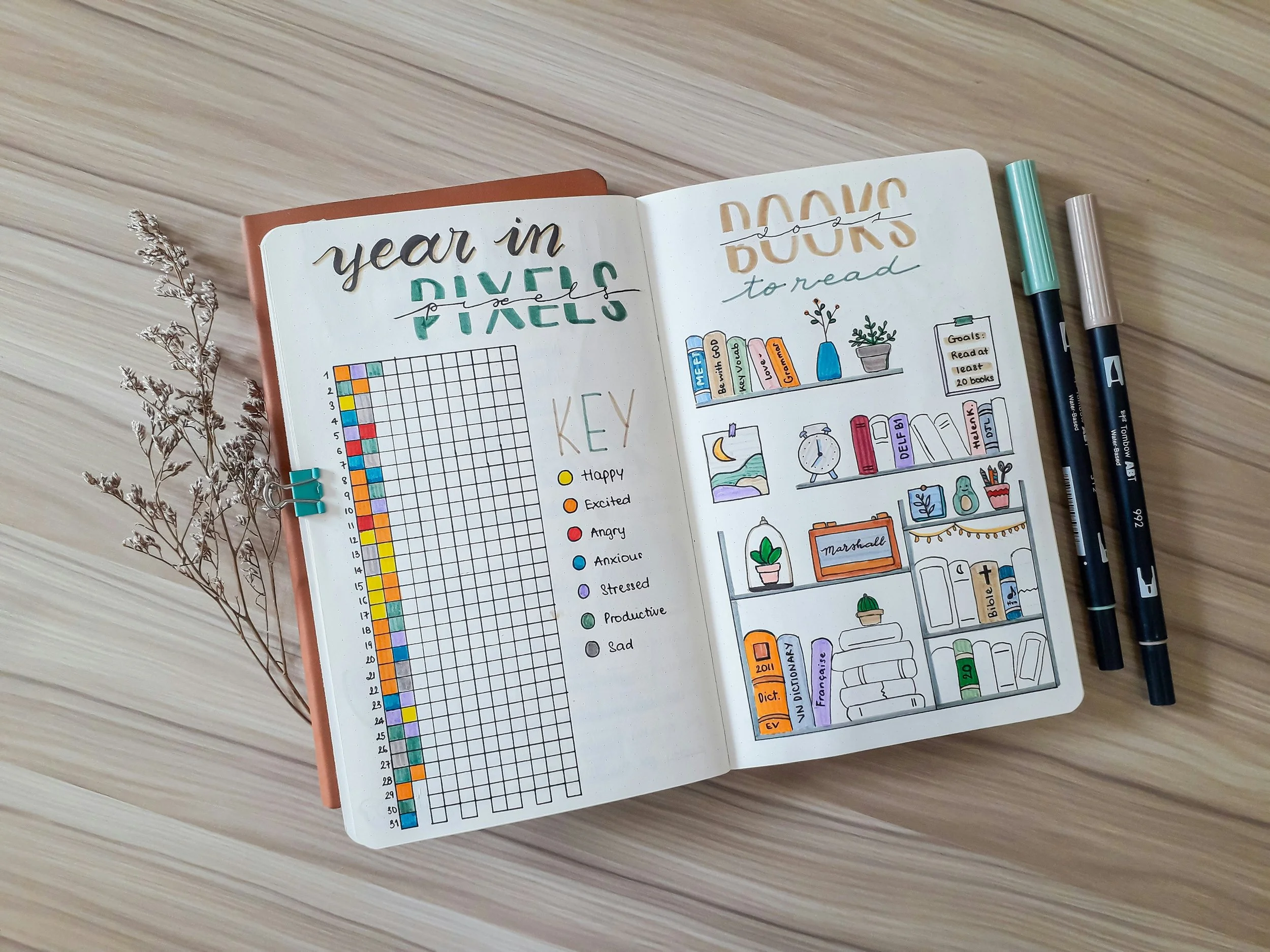
Photo by Ngo Ngoc Khai Huyen on Unsplash
2. Bullet Journal
Bullet journaling, or BuJo if you want to sound like you know what you're talking about, is a productivity and organisation system created by Ryder Carroll that basically turns your notebook into a fully customisable planner, diary and to-do list all in one. The idea is simple: you log tasks, events and notes, and you organise them into daily, weekly and monthly spreads that you design yourself.
What makes it so popular is how flexible it is. It can be as minimal or as elaborate as you want. Some people keep it stripped back, with only a few lines, a simple weekly layout, nothing fancy. Others turn their bullet journals into works of art, with hand-lettered headers, colour coding and intricate illustrations.
If you've ever felt like no planner on the market quite fits the way your brain works, bullet journaling might be the answer.
3. Habit tracker
Similar in spirit to bullet journaling, a habit tracker is exactly what it sounds like: a simple grid or chart where you log the habits you want to build or maintain, and tick them off each day. Want to track your reading, your water intake, your daily walk and your screen-free evenings all in one place? Done. Just you, your notebook and a satisfying row of ticks at the end of a good week.
4. Junk journal
A junk journal is, too, exactly what it sounds like. Instead of filling your notebook with words, you fill it with stuff. Receipts, tickets, postcards, newspaper clippings, packaging you liked too much to throw away, scraps of wrapping paper, photographs, pressed flowers, random little bits and pieces that tell the story of your life in a way that words sometimes can't.
And here's why I think this is particularly perfect for anyone who has ever been afraid of ruining a notebook: because the whole point of a junk journal is to make it messy. There is no wrong way to stick a cinema ticket onto a page. There is no bad way to press a flower between two sheets. The messier, the more layered, the more chaotic, the better.
5. Travel journal
Think tickets, postcards, little maps, the name of that restaurant you need to go back to, phrases you picked up in a language you're still learning. The hidden street you stumbled across on your last afternoon. The "next time I come back" list, because there is always a next time. Anything that will allow you to remember your travels long into the future.

6. Commonplace book
A commonplace book is essentially a physical collection of things you want to remember. Quotes that stopped you mid-page, ideas you don't want to lose, facts that surprised you, passages from books, sentences you overheard somewhere and couldn't shake, questions you're still thinking about.
The practice is actually centuries old. Writers, philosophers and thinkers have kept commonplace books for as long as there have been books to read. But the concept is as relevant now as it ever was.
Think of it as a notebook for your curiosity. A place where your interests, your questions and your discoveries live together. Flick back through it a year later and you'll find a surprisingly accurate portrait of who you were and what you were thinking about.
7. Art journal
No. This one isn’t just for the artists.
An art journal is simply a place to play around with whatever you feel like putting on paper. Doodle in the margins, try a little watercolour, make a collage from old magazines, press a flower between the pages, stick in a photograph, play around with colour palettes, or test out all those pens and pencils you've accumulated.
How I see it, it’s a place to be bad at things. There are no expectations, no one is grading you, and nobody needs to see it. It's just a notebook where you get to make things for the sake of making them.
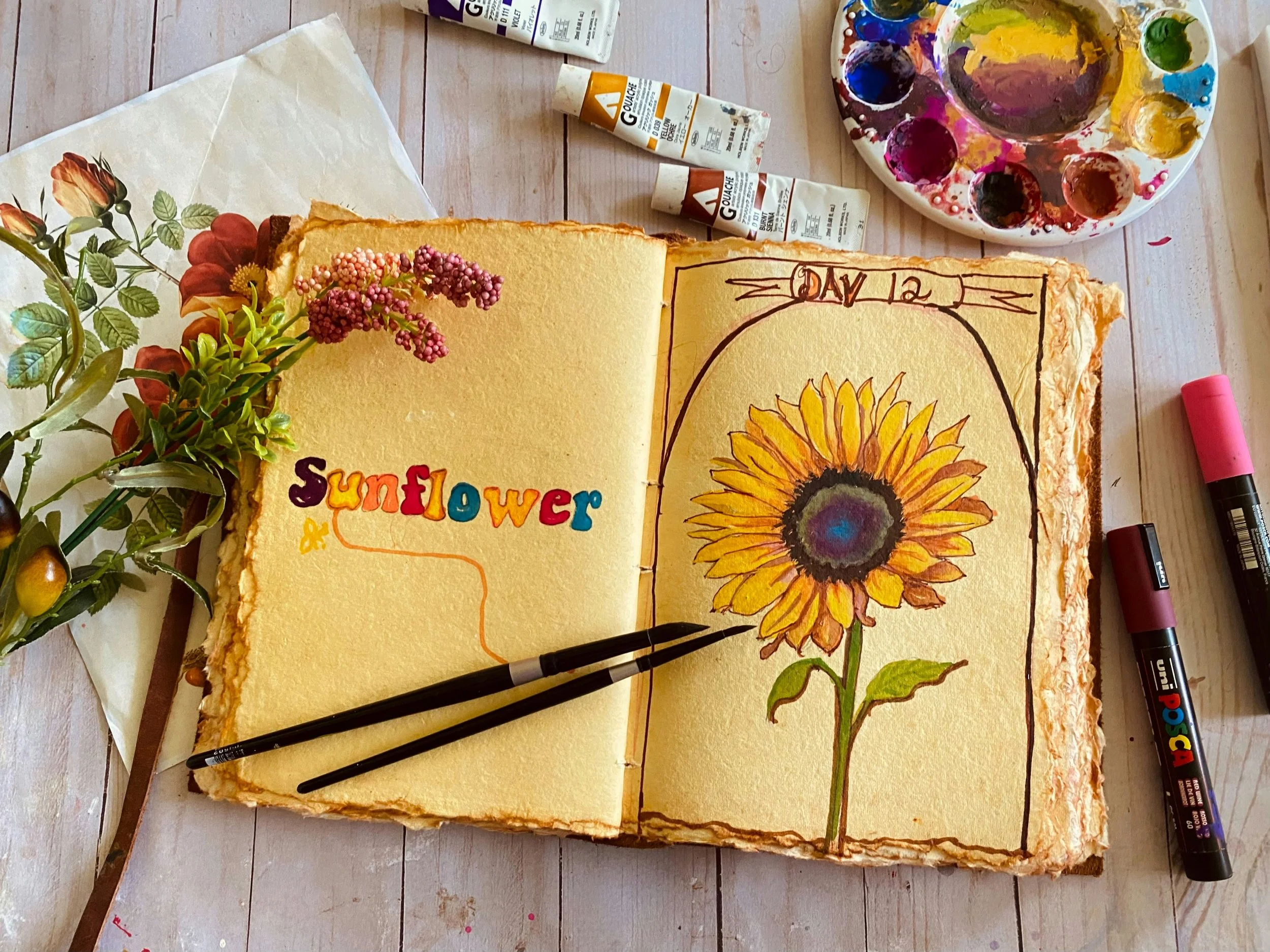
Photo by Creative Girl Creations on Unsplash
8. Recipe book
I recently started doing this for two main reasons.
First, I love the idea of having a collection of recipes that I can eventually pass down.
And second, because sometimes it's late you're hungry, and you have absolutely no idea what to cook. Having a notebook you can open and flip through, filled with meals you already know you love, is incredibly helpful.
9. Book journal
I use my book journal as a log of everything I've read: the title, the author, when I read it, whether I liked it, and how much. You can give each book a rating if that's your thing, or keep it as simple as loved it, liked it, meh, absolutely not. You could even keep track of how long it took you to read it, where you were when you read it, or who recommended it to you.
And, last but not least, my favourite part is writing down what I actually thought about the book. Think of it as your own little analogue book reviews journal. You don't have to write a full, perfectly crafted review every time. A few sentences about what you loved, what annoyed you, whether you liked the ending, which character you couldn't stop thinking about, or simply how the book made you feel can be enough.
Oh, of course, if you're more of a film kinda person, you can do exactly the same thing with films!
10. A notebook for one very specific thing
Endless possibilities:
places you want to visit
restaurants you want to try
things that make you happy
gift ideas
outfits you want to wear
flowers you've spotted
interesting words you've come across
things you've learned
overheard conversations
things you want to remember
your favourite things
lists of things
11. The everything notebook
If you’ve read all the way to here, it might be because you still haven’t found anything in this list that sounds quite right for you. Which is why I kept this one for last. It might be exactly what you need to hear.
Don't give the notebook a purpose at all.
The everything notebook can be anything. Everything goes in it. A shopping list next to a book quote next to a terrible drawing next to a restaurant recommendation next to a thought you had on the bus. A list of things you need to buy. A recipe you want to remember. A little sketch. A film someone recommended. A sentence you overheard. A reminder to book a dentist appointment.
Just your life, as it happens.
Go on. Go open that notebook now
Hopefully, somewhere in all of these ideas, you've found something that makes you want to pick up one of those beautiful notebooks you've been saving. But if not, that's okay too.
